
Unpredictable Rains.
Confident Decisions.
Margaret Ruguru has farmed one and a quarter acres in Njoro, Nakuru County, for as long as she can remember. She used to plant after Good Friday — knowledge passed down and tested across generations. But the seasons have shifted.
This year the rains came in early March. Without an advisory, she would have assumed it was a false start and waited. Instead, she planted on time — with confidence. Because an agro-met advisory told her: now is the moment.
“The message I received on Monday said: ‘You can plant now, the rain is going on.’ So I decided to plant because most of the messages are accurate. The information they give us is accurate.”
Veronica Mukami, 31 · Farmer, Njoro, Nakuru County
“Before, it was just guessing like everyone else.”
John Njugi Karuki, a maize farmer in Kamwago village, Njoro, describes what it was like without a reliable advisory. Suitable Planting Window is designed to replace the guess with a decision — and to deliver it at the exact moment it matters.
John Njugi Karuki · Farmer, Kamwago, Njoro
"Climate change doesn't frighten me. It just requires you to plan yourself according to how the weather is changing."
Margaret Ruguru, 47 Farmer, Njoro · Nakuru County, Kenya
For smallholder farmers, knowing when to plant is one of the most consequential choices of the year.
The seasons are shifting in ways farmers can feel but not predict. David Kariuki, who works with farmers through Regen Organics, remembers planting far later in the year; this season the advisory arrived in early March. The calendars their parents farmed by are becoming less reliable every year.
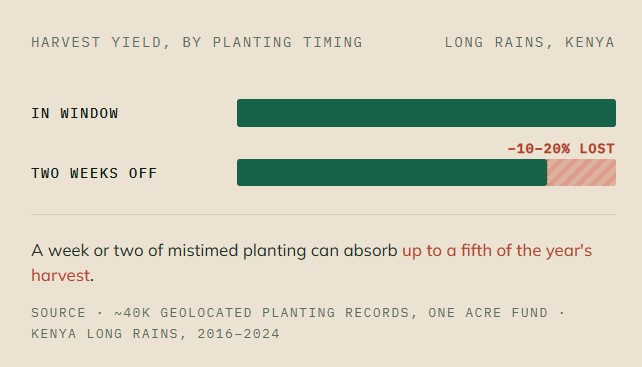
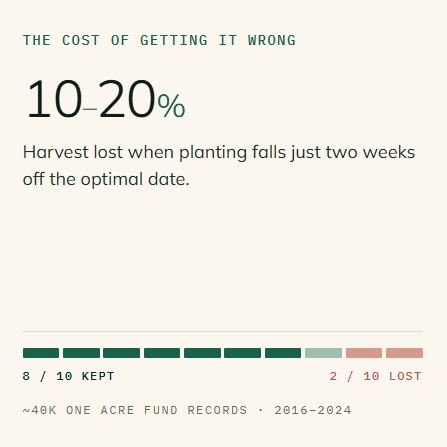
And the stakes are high. Research drawing on planting and yield data from tens of thousands of Kenyan farmers shows that planting just two weeks off the optimal date can cost 10–20% of a harvest — for a family farming an acre or two, the difference between school fees paid and unpaid.
A forecast tells you the weather. We tell farmers what it means for planting.
Suitable Planting Window doesn’t just forecast the weather — it gives farmers the forecast and tells them what to do with it: whether the rain that’s coming means now is the right time to plant.
TomorrowNow works through farmer-facing delivery partners — organizations farmers already know and trust — to put the advisory directly into their hands. One of these partners is Regen Organics, a Kenyan agri-business that provides organic fertilizer and extension support to smallholder farmers across the country.
The advisory arrives by SMS or voice call, in Kiswahili, to any phone — no smartphone required. And because it is localized to the village level, it speaks directly to where a farmer actually is.
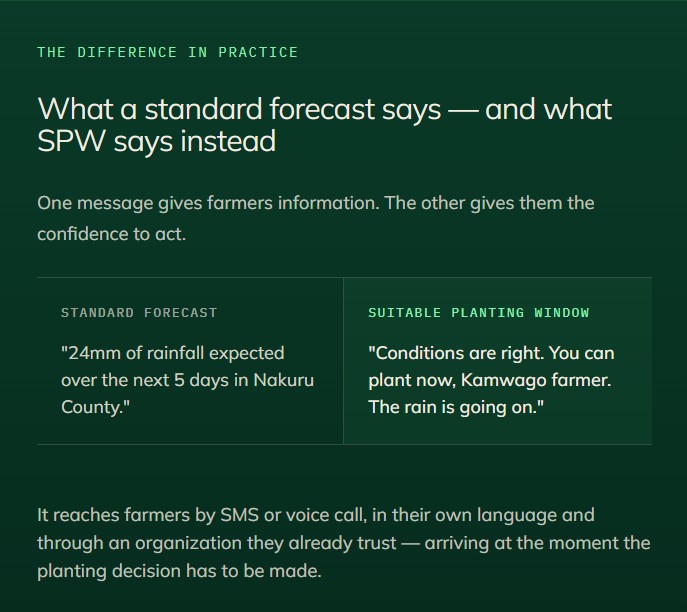
"Other weather updates usually just say there will be a certain amount of millimeters of rain, but they don't tell you it's time to plant. But this one tells us exactly when to plant. So when a farmer plants, they know they aren't missing the window and are right on time. It gives them confidence."
David Kariuki, Lead farmer · Laikipia
How It Works
From a frontier AI weather model to a message on a farmer’s phone.
The advisory reaches farmers through three connected layers — frontier weather science, a clear decision-ready signal, and the trusted partners who deliver it. The technology is powerful, but it is only the beginning of what makes this work.
Frontier AI science
Google's GenCast model generates 50 possible weather futures for each location. Combined with satellite data and a network of 140 ground stations across the region, it produces the most accurate picture of what is coming — validated continuously against what actually happens.
A decision, not a forecast
The forecast data is run through calibrated thresholds — specific to each location, each crop, each growth stage — to produce a single, actionable signal. Not "1.6mm of rain expected." Plant now. Or wait.
Delivered through trust
The advisory reaches farmers through organizations they already have a relationship with — like Regen Organics. It arrives by SMS or voice call, in Kiswahili, to any phone. The intelligence comes from TomorrowNow, and the trusted relationship from our farmer-facing delivery partners — so the farmer gets a decision they can act on with confidence.
The Broader Picture
One advisory. One national program.
One platform designed to last.
Suitable Planting Window is one part of something larger. Today it’s live in Kenya, inside the national climate advisory program — and it’s built to expand to every country we work in. Behind it sits GAP, the Global Access Platform: the open API that partners and institutions plug into to access our weather intelligence and run it in their own name.
Kenya's national climate advisory program
The Digital Climate Advisory Services — in partnership with KALRO and four national institutions. The largest agromet advisory program of its kind in sub-Saharan Africa. Suitable Planting Window is being rolled out inside it.
First production deployment with Regen Organics
The upgraded Suitable Planting Window is live this season for Regen Organics farmers across 15 Kenyan counties and six agro-ecological regions of Kenya. March, April, May 2026 has been one of the most variable seasons on record — and that variability is exactly what the advisory was designed to handle.
A platform built to be owned — not depended on
GAP — the Global Access Platform — is TomorrowNow's open API. Any organization can plug into it to draw on the same weather intelligence that powers Suitable Planting Window and build it into their own tools and channels. Alongside planting, it carries decision-ready advisories for fertilizer timing, spraying, harvest timing, and pest and disease — and it's designed to be hosted and run by the institutions that use it: governments, national agencies, and farmer organizations. Making GAP more agentic over time — so it can carry more of this work autonomously — is an ambition we're actively building toward.
"It rains when the message says it will rain. That is why farmers trust it."
Margaret Ruguru, Farmer, Njoro · Nakuru County
"It rains when the message says it will rain. That is why farmers trust it."
Margaret Ruguru, Farmer, Njoro · Nakuru County